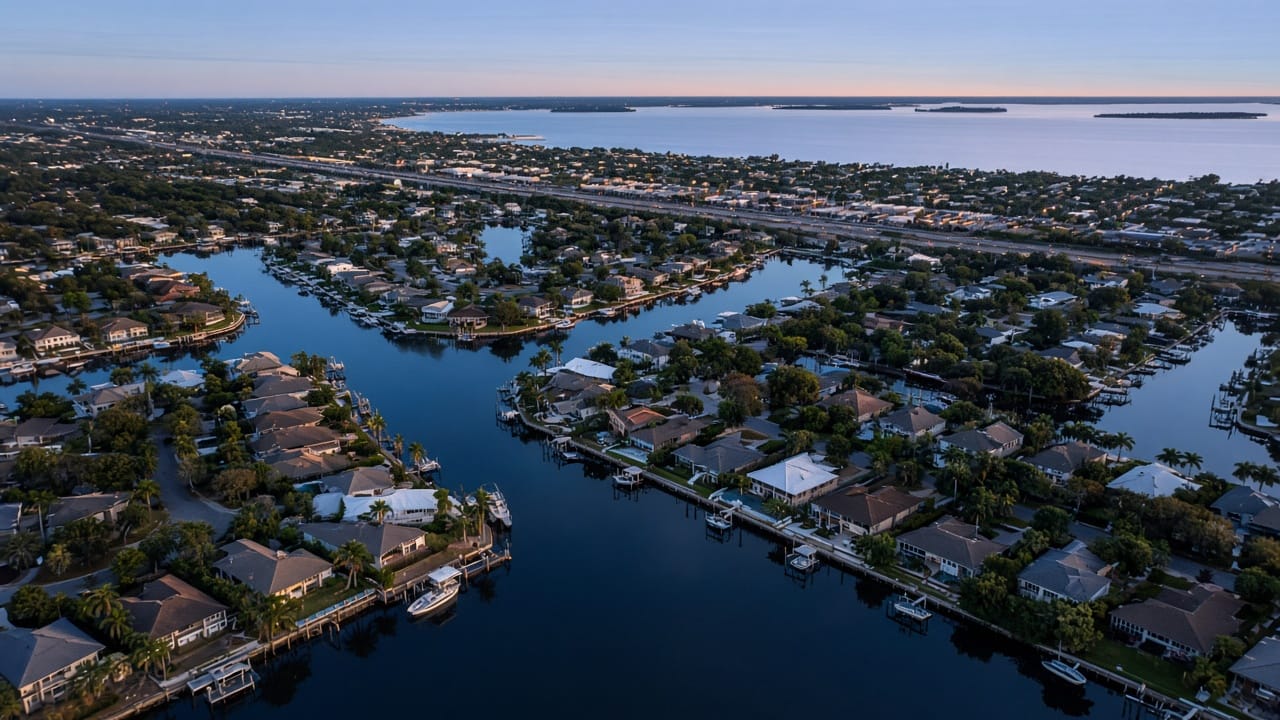
Cape Coral vs Port Charlotte: Which Is Better in 2026?
Cape Coral vs Port Charlotte: side-by-side home prices, inventory, city taxes, utility assessments, canal rules, and offer strategies from a local broker.
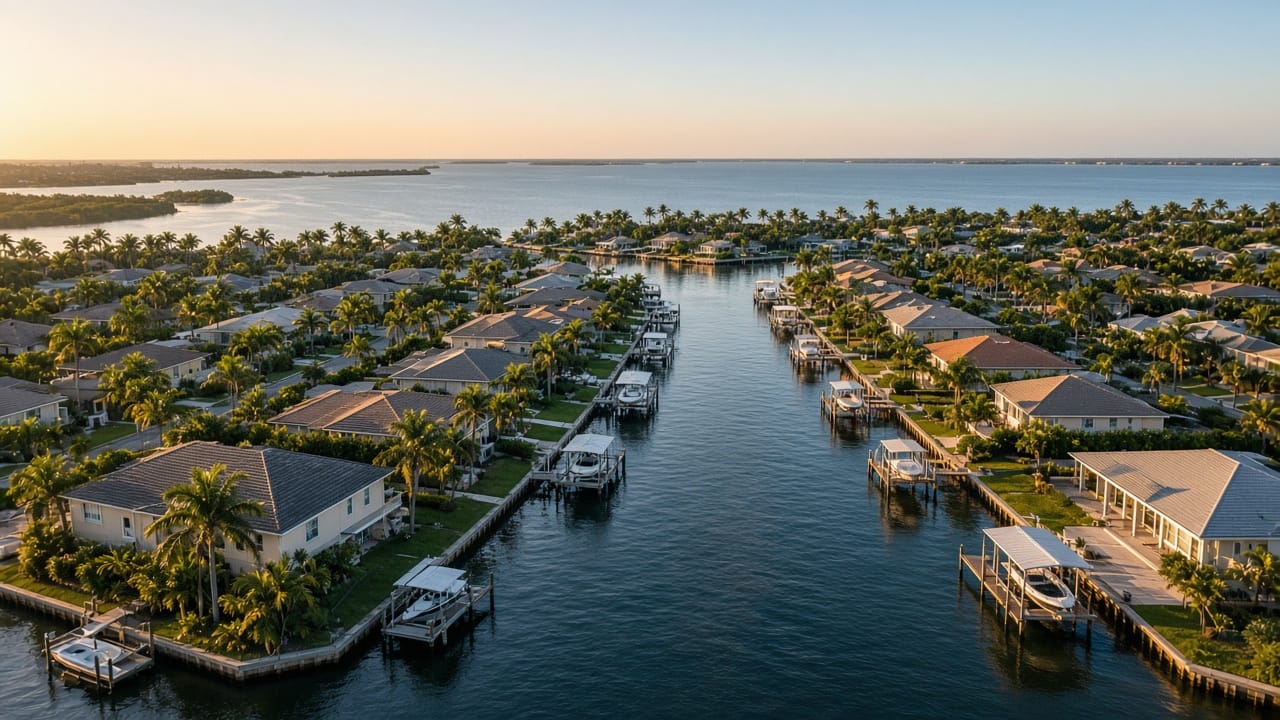
Cape Coral vs Port Charlotte comes down to three real numbers: what you pay for the house, what shows up on the annual tax bill for city taxes and utility assessments, and how long it runs from your dock to open water.
At the time of writing, Port Charlotte's median list price sits in the low $300,000s ($325,000 median list and $294,500 median sold), while Cape Coral sits in the mid-to-upper $300,000s ($399,999 median list and $360,000 median sold) - a structural $60,000 to $75,000 price gap. Both places have miles of canals and plenty of single-family homes. Still, the city tax rules, utility payoffs, bridge clearances, and daily drives are very different.
The Short Version: Side-by-Side Facts
- Home prices run $60,000 to $75,000 lower in Port Charlotte: At the time of writing, Port Charlotte's median list price is $325,000 and median sold price is $294,500 across 1,339 active listings with a median of 77 days on market (Source: tax records, county records, and MLS data). Cape Coral's citywide median list price is $399,999 and median sold price is $360,000 across 5,683 active listings with a median of 82 days on market (Source: Realtor.com Economic Research).
- City tax layer and utility assessments: Cape Coral is an incorporated city in Lee County. Its city operating millage is 5.1471 mills plus 0.1608 mills for debt service, and the city bills special assessments for its Utilities Extension Project (UEP). In the North 1 East UEP area, a standard 10,000-square-foot lot carries a $32,288 initial pre-payment assessment before financing costs, or thousands per year on the tax bill (Source: City of Cape Coral Public Works and Financial Services). Port Charlotte is unincorporated Charlotte County with no city property tax layer and street-by-street water and sewer through Charlotte County Utilities (CCU).
- Canal systems and Gulf of America access: Cape Coral has over 400 miles of canals, split between 150+ miles of saltwater canals and 250+ miles of landlocked freshwater canals separated by weirs. Even on saltwater canals, 67 bridges (many 8 to 10 feet at mean high water) and 5-mph idle zones mean many trips run 30 to 60+ minutes to reach the Caloosahatchee River or Matlacha Pass (Source: City of Cape Coral Public Works GIS). Port Charlotte has sailboat-access canals with no bridges to Charlotte Harbor, powerboat canals with 10-foot bridges like the Edgewater Drive Bridge (check clearance for your boat), and freshwater canals that end at an underground culvert under Tamiami Trail (US-41) with no Gulf of America boat access.
- Daily drives and toll bridges: Cape Coral is a city of over 220,000 residents. Crossing the Cape Coral Bridge or Midpoint Memorial Bridge into Fort Myers carries a $2.00 eastbound bridge toll (Lee County DOT / LeeWay). Port Charlotte has a quieter unincorporated layout and no toll bridges across the Peace River into Punta Gorda.
- Post-Ian inspections matter in both counties: Hurricane Ian came ashore at Cayo Costa on September 28, 2022, then made a second landfall near Punta Gorda. Verify roof permits, elevation certificates, flood zones, and seawalls during your inspection period in either market.
Cape Coral vs Port Charlotte: Home Prices, Inventory, and Negotiating Room
Buyers often start their search looking at both Lee County and Charlotte County because both offer canal living and newer concrete-block homes for less than Naples or Sarasota. When you line up the numbers side by side at the time of writing, the structural $60,000 to $75,000 price gap and the supply difference are clear.
| Market | Median List Price | Median Sold Price | Active Listings | Median Days on Market | Market Condition | Data Source |
|---|---|---|---|---|---|---|
| Port Charlotte, FL | $325,000 | $294,500 | 1,339 | 77 days | Balanced (5.3 mos supply) | Tax records, county records, and MLS data |
| Charlotte County (Overall) | $343,483 | $315,000 | 3,072 | 88 days | Balanced (5.2 mos supply) | Tax records, county records, and MLS data |
| Cape Coral, FL (Citywide) | $399,999 | $360,000 ($234/sq ft) | 5,683 | 82 days | Buyer's Market | Realtor.com Economic Research |
| Cape Coral, FL (3-Month Rolling) | n/a | $379,819 ($209/sq ft) | n/a | 68 days | 1,567 sales (3 mos) | Redfin MLS and public records |
| Cape Coral Region (Single-Family) | n/a | $389,950 ($224/sq ft) | 2,162 (SFR) | 42 days to contract | 4.9 mos supply | Royal Palm Coast Realtor Assoc. / SWFL MLS |
Here is what those numbers at the time of writing mean if you are preparing an offer:
- Port Charlotte gives you a lower entry price on both dry lots and canals. With Port Charlotte sitting in the low $300s ($294,500 median sold and $325,000 median list) and Cape Coral sitting in the upper $300s ($360,000 to $389,950 median sold and $399,999 median list), the typical home in Port Charlotte sells for $60,000 to $75,000+ less than a comparable home in Cape Coral.
- Cape Coral has a large supply of listings to sort through. With 5,683 active listings citywide on Realtor.com (and 2,162 active single-family homes in the RPCRA regional report), buyers in Cape Coral have plenty of choices. Realtor.com rates Cape Coral a buyer's market at the time of writing, with homes selling for an average of 3.46% below asking price (about a 97% sale-to-list ratio).
- Port Charlotte is in a balanced market with real negotiating room. Port Charlotte sits at 77 median days on market, with 5.2 months of supply across Charlotte County and countywide sales volume flat year over year at 0%. Neither side can push the other around. Countywide, waterfront homes sit a median of 102 days (median list $559,000 across 885 active listings), and new construction lists at a median of $369,000 across 787 active listings.
- Check today's live numbers by ZIP code before you bid. Market counts move every week, so check today's current figures on our Port Charlotte market data and Charlotte County market statistics pages.
City Taxes and Utility Assessments vs Unincorporated County
Sticker price is only half the math. The biggest surprise for buyers comparing Cape Coral vs Port Charlotte is what sits on the annual property tax bill below the standard county and school taxes.
Cape Coral: Incorporated City Millage Plus UEP Utility Assessments
Cape Coral is an incorporated city in Lee County with its own city hall, police department, and city tax levy:
- City property tax layer: At the time of writing, the City of Cape Coral levies an operating millage rate of 5.1471 mills plus 0.1608 mills for Parks General Obligation Bond debt service (Source: City of Cape Coral Annual Budget, Ordinance 49-25). That city tax sits on top of Lee County, Lee County School District, and fire/water district millages.
- Utilities Extension Project (UEP) special assessments: Cape Coral was originally platted with shallow wells and septic tanks. To protect groundwater and canals, the city has been extending municipal potable water, wastewater (sewer), and irrigation water lines across the city under Ordinance 8-99 ("growth pays for growth"). Almost all of south Cape Coral is complete, and active construction and billing now cover major areas north of Pine Island Road (such as North 2, North 1 West, North 1 East, and North 3).
- What the UEP costs on a standard lot: The city bills two pieces: a Line Extension assessment based on lot square footage (1 Equivalent Parcel = 10,000 square feet) and a Capital Facility Expansion Charge (CFEC) per Equivalent Residential Unit (ERU). In the North 1 East UEP area, the initial cash pre-payment cost for a standard 10,000-square-foot lot is $32,288 before financing charges: $8,221 for water, $9,607 for sewer, and $7,710 for irrigation line extensions ($25,538 total), plus $6,750 in CFEC charges (Source: City of Cape Coral Public Works and Financial Services UEP Assessment Schedule). Earlier phases ranged from $10,296 (Pine Island) to $24,742 (Southwest 4) before financing.
- How it hits a buyer: If the seller did not pre-pay the UEP assessment in cash, the balance rides on the annual Lee County property tax bill as a non-ad valorem assessment for 20 to 30 years with interest. That adds thousands of dollars a year to your carrying cost, on top of plumber hookup and septic-abandonment costs. Whenever you shop in Cape Coral, verify the exact UEP status of the parcel. Write into the contract whether the seller will pay off the remaining UEP balance at closing or whether you are assuming the balance in your offer price.
Port Charlotte: Unincorporated County With No City Tax Layer
Port Charlotte is not an incorporated city. It is an unincorporated community governed directly by Charlotte County:
- No city millage rate: Homeowners in Port Charlotte do not pay an incorporated city property tax. Your ad valorem tax bill covers Charlotte County, the school board, law enforcement, and water management districts (about 15.09 mills combined ad valorem on the Charlotte County tax roll at the time of writing, before homestead exemptions).
- Non-ad valorem MSBU assessments: Instead of a city tax, Port Charlotte parcels carry Charlotte County Municipal Service Benefit Unit (MSBU) assessments for street and drainage maintenance, fire rescue, sanitation, and (on waterfront lots) canal dredging/waterway maintenance.
- Water and sewer work street by street: Charlotte County Utilities (CCU) operates central water and sewer across much of Port Charlotte. Other blocks have central CCU water with a private septic system, and outer pockets use private well and septic. Where Charlotte County runs a multi-year septic-to-sewer conversion zone, affected parcels have a specific sewer MSBU assessment. Always pull the parcel's current tax bill on the Charlotte County Tax Collector site during your inspection period so you know the exact utility setup and every non-ad valorem line item.
This is general real estate information, not tax or legal advice. Confirm parcel-specific tax bills, homestead portability, and assessment payoffs with the county property appraiser, tax collector, or a tax professional.
Boating and Canal Reality: Cape Coral vs Port Charlotte
More waterfront buyers get burned by canal assumptions than by anything else. A blue line behind the house on a map does not mean your boat can reach the Gulf of America in 15 minutes.
How Cape Coral's 400+ Miles of Canals Work
Cape Coral has more than 400 miles of canals, split into more than 150 linear miles of saltwater canals and more than 250 linear miles of freshwater canals (Source: City of Cape Coral Public Works and GIS):
- Freshwater canals are landlocked: Concrete weirs separate Cape Coral's freshwater canals and lakes from the tidal saltwater network. Freshwater canals are great for bass fishing, kayaking, and local pontoon cruising, but boats cannot pass over the weirs to reach the river or the Gulf of America.
- Direct vs indirect saltwater access: Saltwater canals in the Southeast (Yacht Club and Bimini Basin areas) and parts of the Southwest (around Cape Harbour and Tarpon Point) offer direct access with no fixed bridges to the Caloosahatchee River. Thousands of interior saltwater lots have indirect access instead. From those docks, your boat must pass under one or more of the city's 67 canal bridges, and many of them have 8- to 10-foot vertical clearances at mean high water.
- Chiquita Lock removal: The Chiquita Lock in Southwest Cape Coral was permanently removed by the city, leaving zero active boat locks. Former lock-gated Southwest canals now flow directly toward the river. Boaters still need to watch for shallow spots near the former lock site and check every fixed bridge along their route.
- Watch the 5-mph idle time: Because Cape Coral's canal grid is so deep inland, a saltwater canal home can be 3 to 8 miles of winding 5-mph no-wake zones away from open water. Depending on the block, it can easily run 30 to 60+ minutes at idle speed just to reach the Caloosahatchee River or Matlacha Pass, before you ever reach San Carlos Bay or the Gulf of America.
How Port Charlotte's Three Canal Types Work
In Port Charlotte, canal homes sit right along the northern edge of Charlotte Harbor, one of Florida's largest natural estuaries, known for tarpon and backwater fishing. Port Charlotte canals fall into three clear types:
- Saltwater sailboat-access canals: These canals have no bridges between your dock and Charlotte Harbor. Once you clear the short canal mouth into the harbor, you have a clear run out to Boca Grande Pass and the Gulf of America.
- Saltwater powerboat canals: These canals have 10-foot fixed bridges between your dock and Charlotte Harbor, including the Edgewater Drive Bridge at 10 feet. Check clearance for your boat - including T-tops, hardtops, radar arches, and antennas - before you write an offer.
- Freshwater canals: Port Charlotte's inland freshwater canals connect only to other freshwater canals and small lakes. They end at an underground road culvert under Tamiami Trail (US-41). Water flows through the culvert, but boats and floating devices cannot pass through it, so freshwater canal homes have no harbor or Gulf of America access by boat.
Before you buy on any canal, factor in seawall, dock, and lift ownership costs. We break down those numbers in our Punta Gorda and Port Charlotte canal homes true cost guide, and you can filter active listings by canal type on our waterfront homes page.
Daily Life, Traffic, Toll Bridges, and Storm Recovery
Even if two houses look identical from the street, day-to-day living in Cape Coral and Port Charlotte feels very different.
Population, Commuting, and the $2 Bridge Toll
- Cape Coral has grown into a large city of more than 220,000 residents. The city sits on a peninsula bounded by the Caloosahatchee River to the east and Matlacha Pass to the west. Driving into Fort Myers for I-75 access, hospitals, airport runs (RSW), or work funnels traffic across two main river crossings: the Cape Coral Bridge and the Midpoint Memorial Bridge (plus the US-41 bridges farther north). Both the Cape Coral Bridge and the Midpoint Bridge charge a $2.00 eastbound toll entering Fort Myers via LeeWay or SunPass toll-by-plate (Source: Lee County DOT).
- Port Charlotte is smaller, quieter, and spread around the Peace River and Myakka River corridors. There are no toll bridges in Port Charlotte or Punta Gorda. Crossing the US-41 Barron Collier Bridge into downtown Punta Gorda for waterfront dining, marinas, Gilchrist Park, or the Punta Gorda Airport (PGD) is free, and I-75 runs right along the eastern side of Port Charlotte. For Gulf of America beaches, Port Charlotte residents drive west to Englewood Beach, Manasota Key, or Boca Grande. You can explore street layouts and local amenities on our Port Charlotte community page.
If schools are part of your move, check the official Lee County School District or Charlotte County Public Schools boundary maps and state information for the exact property address.
Hurricane Ian and the 6-Step Buyer Inspection Checklist
Both communities were tested by Hurricane Ian, which came ashore at Cayo Costa on September 28, 2022, then made a second landfall near Punta Gorda. Both Cape Coral and Port Charlotte have rebuilt extensively since 2022, with thousands of new roofs, repaired seawalls, and updated homes meeting current Florida Building Code wind standards.
Whether you buy in Cape Coral or Port Charlotte, insurance carriers price the individual house, not the city name. Use this 6-step checklist during your inspection period on every offer:
- Pull the FEMA flood zone for the exact parcel (Zone X, AE, or VE) so you know whether a lender will require flood insurance.
- Ask for an existing Elevation Certificate (or order one during inspection) so your insurance agent can rate the home's actual finished-floor height.
- Order both a 4-Point Inspection and a Wind Mitigation Inspection. Roof age, roof-to-wall clips or straps, secondary water resistance, and impact windows or shutters drive your wind premium.
- Verify that all post-Ian roof, lanai, electrical, and dock permits were finaled and closed with the City of Cape Coral or Charlotte County building department. Open or expired permits delay closings.
- Hire a marine contractor to inspect the seawall, cap, tie-backs, dock, and boat lift on any canal home. Look for soil washout (voids) behind the seawall cap and cracking at the waterline.
- Lock in written homeowners and flood insurance quotes before your inspection contingency expires. Never rely on what the seller paid under an older policy.
Our hurricane preparedness guide covers how local waterfront owners prep their docks, lifts, and homes each summer.
If You Are Moving From Cape Coral to Port Charlotte
Every month I talk with homeowners in Cape Coral who love being on the water. Many want to cash out some equity, get away from bridge tolls and UEP assessments, and move 35 minutes north to Port Charlotte or Punta Gorda. If you are planning that move:
- Compare your net proceeds against Port Charlotte canal prices. Selling a $400,000+ home in Cape Coral and buying in a market where the median sold price is $294,500 can reduce or eliminate a mortgage, especially if you are paying off a UEP balance at closing.
- Check your Florida Save Our Homes portability. Florida law allows eligible homestead owners to transfer up to $500,000 of their accumulated Save Our Homes assessment benefit to a new Florida homestead within the time window allowed by Florida law, even when moving from Lee County to Charlotte County. Confirm your exact portability math with the Charlotte County Property Appraiser.
- Measure your boat before you pick a Port Charlotte street. If you kept a center-console with a high T-top or radar arch on a direct-access canal in Cape Coral, verify whether it clears Port Charlotte's 10-foot powerboat bridges or whether you should shop strictly on Port Charlotte's no-bridge sailboat canals.
What I Tell Clients Comparing Both Markets
I have been licensed in Florida real estate since 2002 and have spent over 20 years helping buyers and sellers across Charlotte County's canals and neighborhoods. Here is the straight advice I give anyone weighing Cape Coral vs Port Charlotte:
- Choose Cape Coral if you want a larger city with more nightlife and dining inside city limits, need a daily commute into Fort Myers or southern Lee County, and budget upfront for city property taxes, UEP utility assessments, and longer idle times in the canals.
- Choose Port Charlotte if you want a lower purchase price ($294,500 median sold vs $360,000), no incorporated city tax layer, no toll bridges into Punta Gorda, and quick access to Charlotte Harbor fishing and the Gulf of America.
Next Steps
If you are comparing streets, canal depths, or bridge clearances in Port Charlotte, download our free Charlotte County relocation guide or see how we represent buyers on our buyer services page. If you already own a home and want to see what it would sell for in today's market, run a free home valuation.
Talk to Leo Albanes, local broker since 2002. Call (941) 337-3391 or contact Leo directly.
Leo Albanes
Broker-Owner, Charlotte County Properties Inc.
Florida Real Estate Broker License #BK3054900
Over 20 years helping buyers, sellers, and investors navigate Charlotte County. Punta Gorda-based. Se habla español.