
A Unique Piece of Florida's Natural Heritage
The Florida Scrub-Jay (Aphelocoma coerulescens) is Florida's only endemic bird species—found nowhere else in the world. This remarkable bird has existed as a distinct species for at least two million years, making it an irreplaceable part of Florida's natural heritage.
For Charlotte County residents and prospective homebuyers, understanding the Florida Scrub-Jay is essential. As a federally and state-listed threatened species, scrub-jays influence land use, development regulations, and conservation efforts throughout the region.
Conservation Status
- ✓ Federal: Threatened (U.S. Fish & Wildlife Service)
- ✓ State: Threatened (Florida FWC)
- ✓ IUCN: Vulnerable
- ✓ Population: Only 7,500-10,000 remain (90% decline)
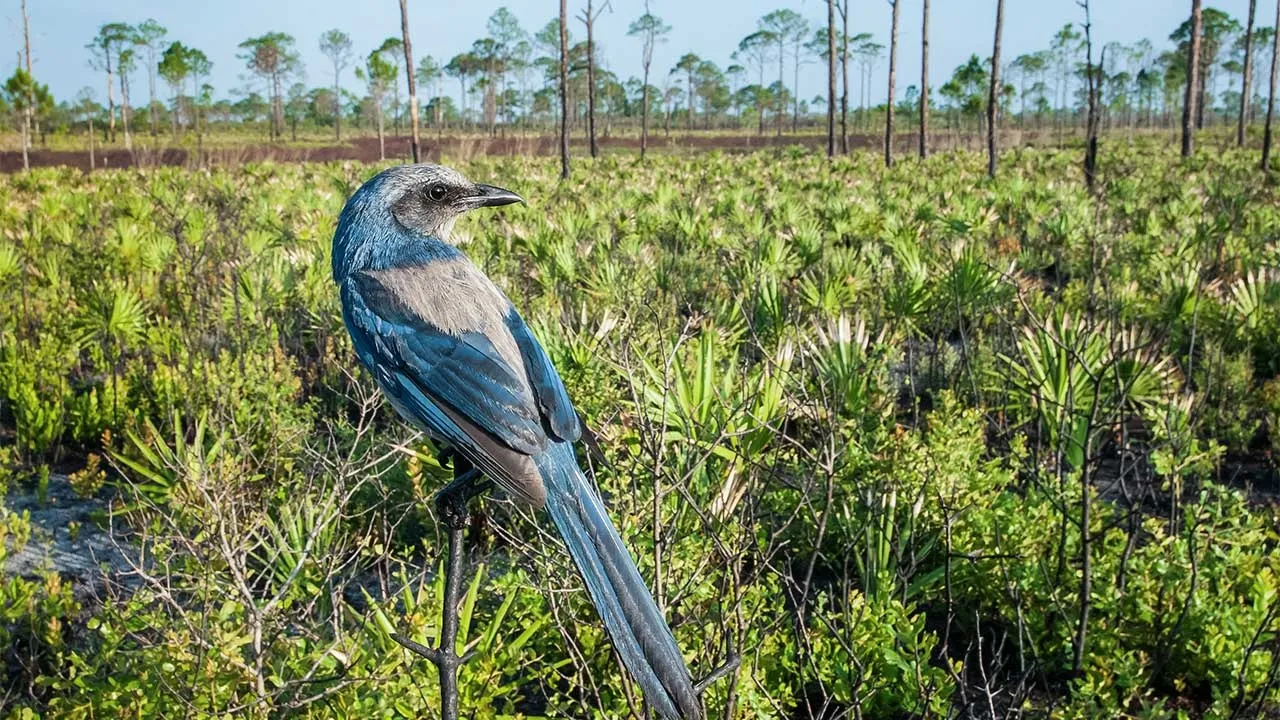
What is a Florida Scrub-Jay?
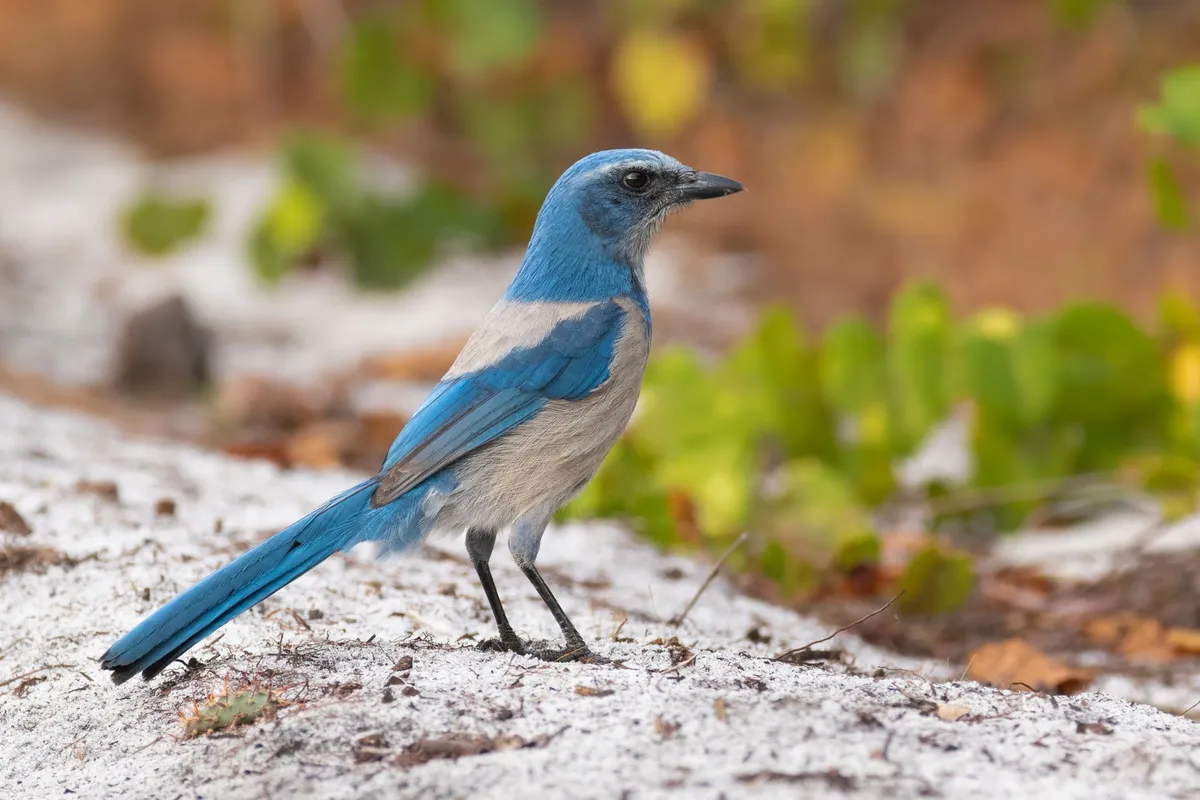
Physical Appearance
Florida Scrub-Jays are medium-sized birds measuring 9.8-11.8 inches in length with a wingspan of 13-14 inches. They display striking pale blue plumage on their head, nape, wings, and tail, contrasted with pale gray backs and bellies.
Distinctive Features:
- ✓ White throat and chest with blue-gray bib
- ✓ Whitish forehead and eyebrow area
- ✓ Strong black bill and black legs
- ✓ No crest (unlike other jay species)
- ✓ No white-tipped wings or tail feathers
Juvenile birds display dull brown upperparts that gradually transition to blue as they mature. Males are slightly larger than females, though both sexes share similar plumage.
Remarkable Behavior and Social Structure
Cooperative Breeding
Florida Scrub-Jays exhibit a fascinating cooperative breeding system. They live in extended family groups (2-8 individuals) consisting of a breeding pair and "helper" birds—often their offspring from previous years.
Helper birds assist by defending territory, providing food for young birds, and acting as lookouts for predators. This cooperative behavior increases the survival rate of fledglings and demonstrates the species' remarkable intelligence.
Territory and Social Hierarchy
Each family group maintains a permanent territory of 22-24 acres. Within the family, breeding males are most dominant, followed by helper males, breeding females, and helper females.
Males typically inherit their natal territory when the breeding male dies, while females emigrate to establish breeding territories elsewhere. This territorial behavior is one reason habitat fragmentation is so devastating to the species.
Important: Do Not Feed Scrub-Jays
Despite their tameness and curiosity, feeding Florida Scrub-Jays is illegal under federal and state law. Feeding causes birds to reproduce earlier, leading to fledgling malnutrition when natural food sources aren't available. It also increases road mortality risk.
Diet and Foraging
Florida Scrub-Jays are omnivorous with a varied diet. Acorns form a crucial component, and they cache thousands annually for winter consumption, playing an important role in oak seed dispersal.
Their diet includes:
- • Acorns (primary food source)
- • Other nuts and fruits
- • Insects (grasshoppers, butterflies, caterpillars)
- • Bird eggs
- • Small vertebrates (frogs, snakes, lizards, mice)
Reproduction
Breeding occurs from early March to late June. The breeding pair constructs nests 3-6 feet off the ground in shrubby oaks.
Breeding Facts:
- • Clutch size: 1-5 eggs
- • Incubation: 17-18 days (female only)
- • Fledging: 16-21 days after hatching
- • Entire family helps feed young
- • Fledglings dependent for ~10 weeks
⚠️ Vegetation clearing prohibited March 1 - June 30 during nesting season
Specialized Habitat Requirements
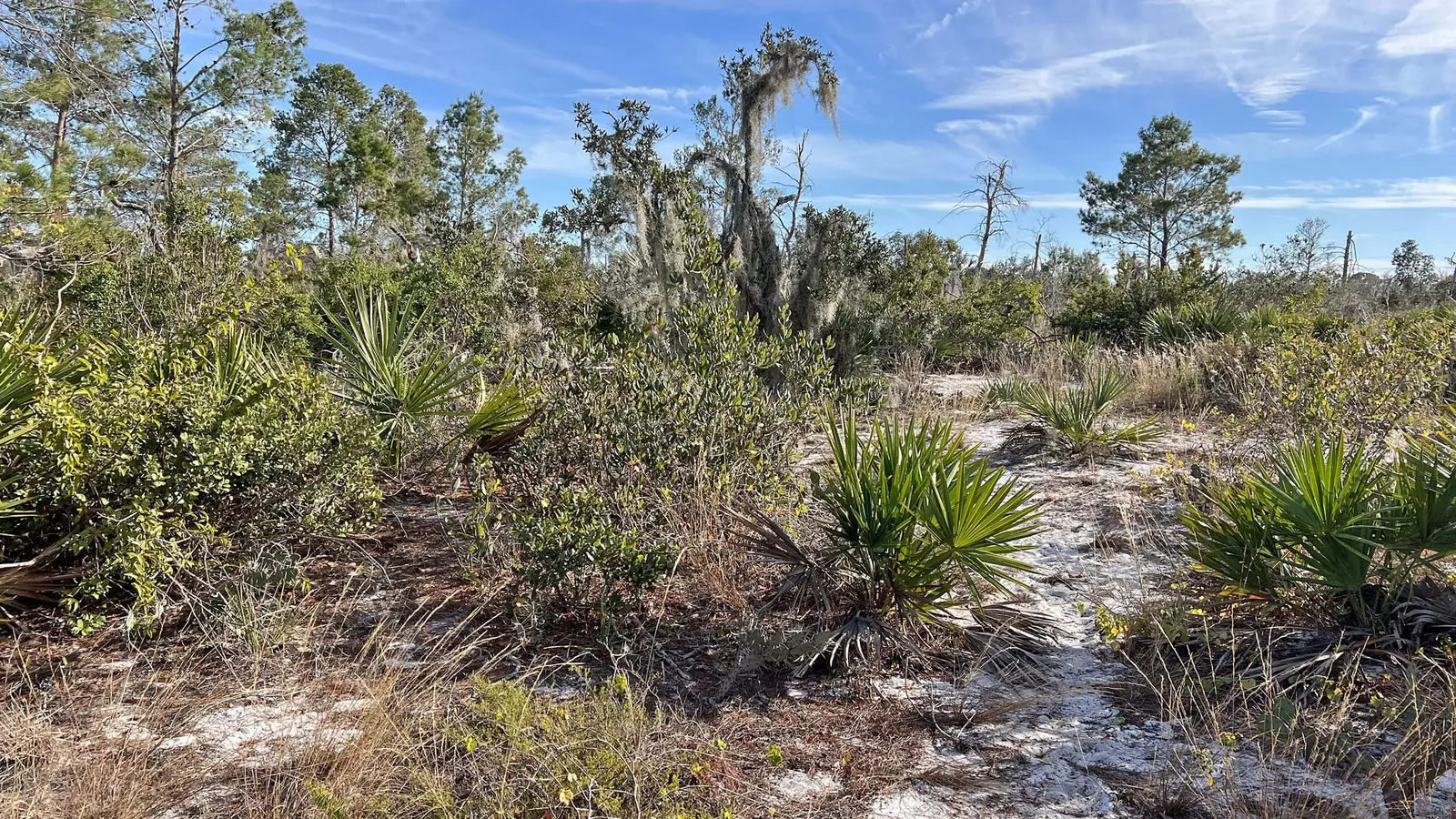
Florida scrub habitat: Sandy soils, low-growing scrub oaks, and open patches essential for scrub-jay survival
Low Vegetation
Scrub oaks at optimal heights of 4-5.5 feet with over 50% coverage. Vegetation maintained by periodic fire.
Open Sandy Areas
Numerous patches of bare sand or sparse vegetation, vital for foraging and predator detection.
Large Territories
Each family requires 22-24 acres of permanent territory. Habitat fragmentation prevents territory establishment.
🔥The Critical Role of Fire
Fire ecology is absolutely essential to maintaining suitable scrub-jay habitat. Historically, natural fires occurred at intervals between 10 and 100 years, maintaining the low vegetation structure scrub-jays require.
Decades of fire suppression have allowed scrub habitats to become overgrown with tall trees, making them unsuitable for scrub-jays. Without active habitat management through prescribed burning, scrub-jay populations inevitably decline.
The birds' preference for frequently burned, open scrub is driven by predation pressure—short vegetation allows them to monitor large areas for predators while still providing refuge and access to acorns.
Conservation Status and Threats
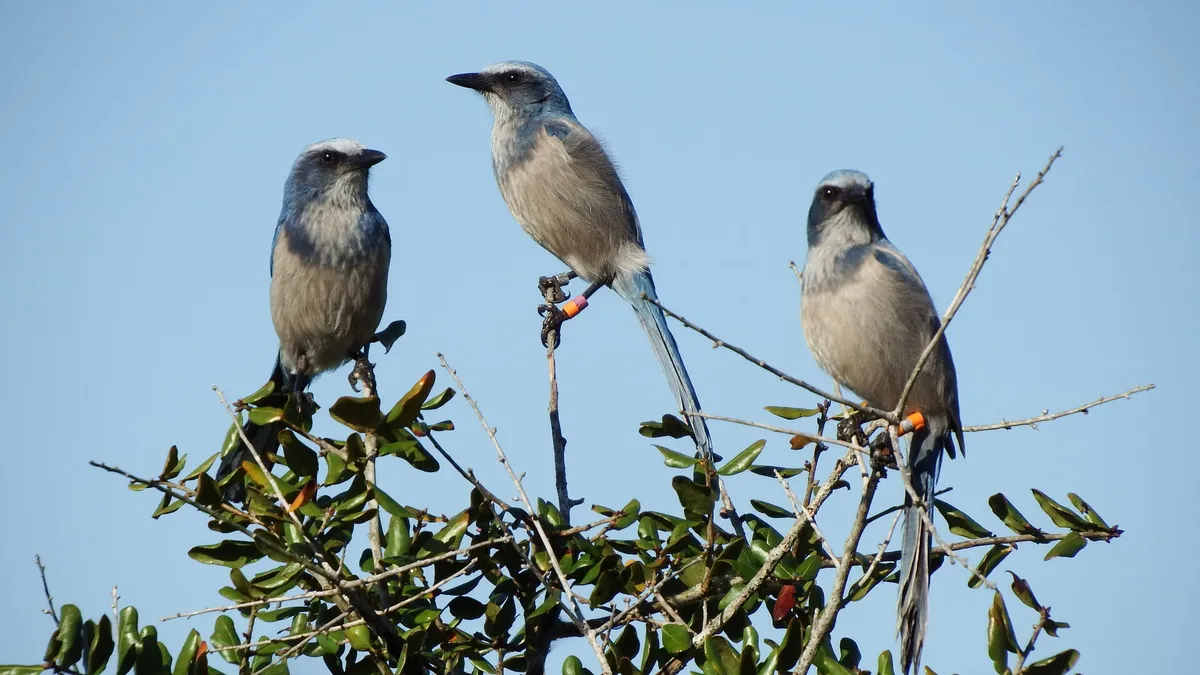
Scrub-jays' tameness makes them excellent subjects for conservation research and education
Catastrophic Population Decline
The Florida Scrub-Jay has experienced more than 90% population reduction from original numbers. Current estimates suggest only 7,500 to 10,000 individuals remain, with no more than 1,000 in any single subpopulation.
Critical Threat Factors:
- 🏗️ Habitat Loss: Only 15% of original scrub habitat remains
- 🌳 Fire Suppression: Overgrown vegetation eliminates suitable habitat
- 🌡️ Climate Change: Sea-level rise, altered precipitation, extreme weather
- 🐱 Predation: Domestic cats, dogs, snakes, hawks, raccoons
- 🚗 Vehicle Collisions: Major cause of death in developed areas
Some experts predict scrub-jays may disappear from certain areas within a decade without aggressive conservation action. The species' survival depends on protecting and managing remaining habitat while restoring degraded scrub ecosystems.
Why Habitat Loss is Devastating
Because each family requires 22-24 acres of permanent territory, habitat fragmentation creates an impossible situation for young birds trying to establish new territories.
As development and agriculture convert scrub habitat to other uses, remaining habitat patches become isolated "islands" surrounded by unsuitable land. Young scrub-jays attempting to disperse and find new territories often cannot survive the journey between habitat fragments.
Additionally, edge effects make habitat near development less suitable. Predator populations increase near developed areas, vegetation structure changes, and human disturbance disrupts natural behaviors.
This is why conservation efforts focus on protecting large, connected habitat patches and restoring habitat connectivity through land acquisition and conservation easements.
Florida Scrub-Jays and Charlotte County Real Estate
Charlotte County's Habitat Conservation Plan (HCP)
Charlotte County has implemented a comprehensive Habitat Conservation Plan that balances real estate development with Florida Scrub-Jay conservation. This county-wide approach represents a significant advancement in managing the intersection of property rights and endangered species protection.
Reserve Network
Approximately 4,500 acres of managed land to protect scrub-jay habitats
Streamlined Process
Blanket Incidental Take Permit eliminates individual federal permitting delays
Tiered Fees
Development fees fund land acquisition, restoration, and habitat management
What Property Owners Need to Know:
1. Determine if Your Property is Affected
Charlotte County provides GIS mapping showing "Scrub-jay Permit Boundary" areas. Check with the county or your real estate agent to determine if your property falls within these zones.
2. Understand the Fee Structure
For lots between 0.23-0.49 acres: $4,000 fee (as of Feb 2025). Larger parcels face proportionally higher fees. This is significantly lower than the $15,000-$20,000 cost of individual permitting before the HCP.
3. Seasonal Restrictions
No vegetation clearing March 1 - June 30 during nesting season. Plan development timelines accordingly.
4. Survey Requirements
Properties in scrub-jay zones may require environmental consultant surveys, conducted during nesting season (March-October) for permitting purposes.
Benefits of Charlotte County's HCP
- ✓Lower Costs: $4,000 vs. $15,000-$20,000 for individual permitting
- ✓Faster Process: Weeks instead of 12+ months
- ✓Predictable: Clear fee structure and requirements
- ✓Conservation Impact: Fees fund habitat protection and restoration
Penalties for Non-Compliance
⚠️ Land clearing without approved permits in scrub-jay habitats:
- • Fines up to $100,000 for individuals
- • Fines up to $200,000 for businesses
- • Potential jail time
- • Required habitat restoration
Always consult with Charlotte County planning department and your real estate professional before beginning any land clearing or development activities.
Environmental Impact and Ecosystem Role
Indicator Species
As the only bird species that exclusively requires sandy, scrubby habitat, the Florida Scrub-Jay serves as a critical indicator of the health of Florida's imperiled scrub ecosystem.
Its declining numbers directly reflect the degradation and loss of these unique scrublands, making it a flagship species for broader conservation efforts that benefit the entire ecosystem.
Seed Dispersal
Florida Scrub-Jays play a vital role in scrub oak regeneration through their acorn-caching behavior.
By storing thousands of acorns annually throughout their territory, they inadvertently plant oak trees when cached acorns are forgotten or not retrieved, contributing to the long-term maintenance of the scrub ecosystem.
Conservation Catalyst
The scrub-jay's protected status has driven significant habitat restoration and management efforts throughout Florida, including:
- 🔥Prescribed Burning Programs: Rejuvenating overgrown scrub habitat
- 🌿Invasive Species Removal: Restoring native scrub vegetation
- 🏞️Habitat Protection: Preserving large connected habitat patches
- 🔬Research Initiatives: Understanding conservation needs
These conservation actions benefit the entire scrub ecosystem and the many other species that depend on it, including gopher tortoises, Florida mice, and numerous rare plants.
Why Florida Scrub-Jays Matter to Charlotte County Residents
Unique Natural Heritage
Charlotte County residents share their community with a species found nowhere else on Earth—a creature representing two million years of evolutionary history unique to Florida.
Property Value Considerations
Understanding scrub-jay regulations is essential for accurate development cost projections, timeline planning, and informed real estate decisions.
Educational Opportunities
Local preserves offer opportunities to observe scrub-jays up close, learn about fire ecology, and participate in citizen science programs.
How You Can Help
Simple Actions Make a Difference:
- ✓Keep Cats Indoors: Protect scrub-jays from predation
- ✓Don't Feed Wildlife: Maintain natural behaviors and prevent harm
- ✓Reduce Pesticides: Protect insect food sources
- ✓Support Conservation: Visit local preserves and learn more
Conservation Responsibility:
Charlotte County residents play a direct role in the survival of an entire species. Decisions made today about development, habitat protection, and conservation will determine whether future generations have the opportunity to experience Florida Scrub-Jays.
As one of Florida's most distinctive and charismatic species, the scrub-jay represents a living connection to the state's natural history—a connection that, once lost, can never be recovered.
Frequently Asked Questions
What should I do if I see a Florida Scrub-Jay on my property?
Consider yourself fortunate! Observe and photograph them from a respectful distance, but do not feed them or allow pets to chase them. If you're planning development, contact Charlotte County planning department to understand permit requirements.
How long does scrub-jay permitting take in Charlotte County?
Under Charlotte County's HCP, the process typically takes a few weeks compared to 12+ months for individual federal permitting. The county's blanket Incidental Take Permit significantly streamlines the process.
Can scrub-jay regulations affect my property value?
Scrub-jay designations can affect development costs and timelines, which may influence property values. However, Charlotte County's HCP provides a predictable, cost-effective process. Consult with your real estate agent about specific property impacts.
Where can I see Florida Scrub-Jays in Charlotte County?
Several Charlotte County preserves and parks offer opportunities to observe scrub-jays. Contact the Charlotte County Parks & Natural Resources Department or visit local nature centers for information about viewing locations and guided tours.
What happens if I clear land without a scrub-jay permit?
Unauthorized land clearing in scrub-jay habitat is a serious federal violation. Penalties can include fines up to $100,000 for individuals ($200,000 for businesses), potential jail time, and mandatory habitat restoration. Always obtain proper permits before beginning any land clearing.