
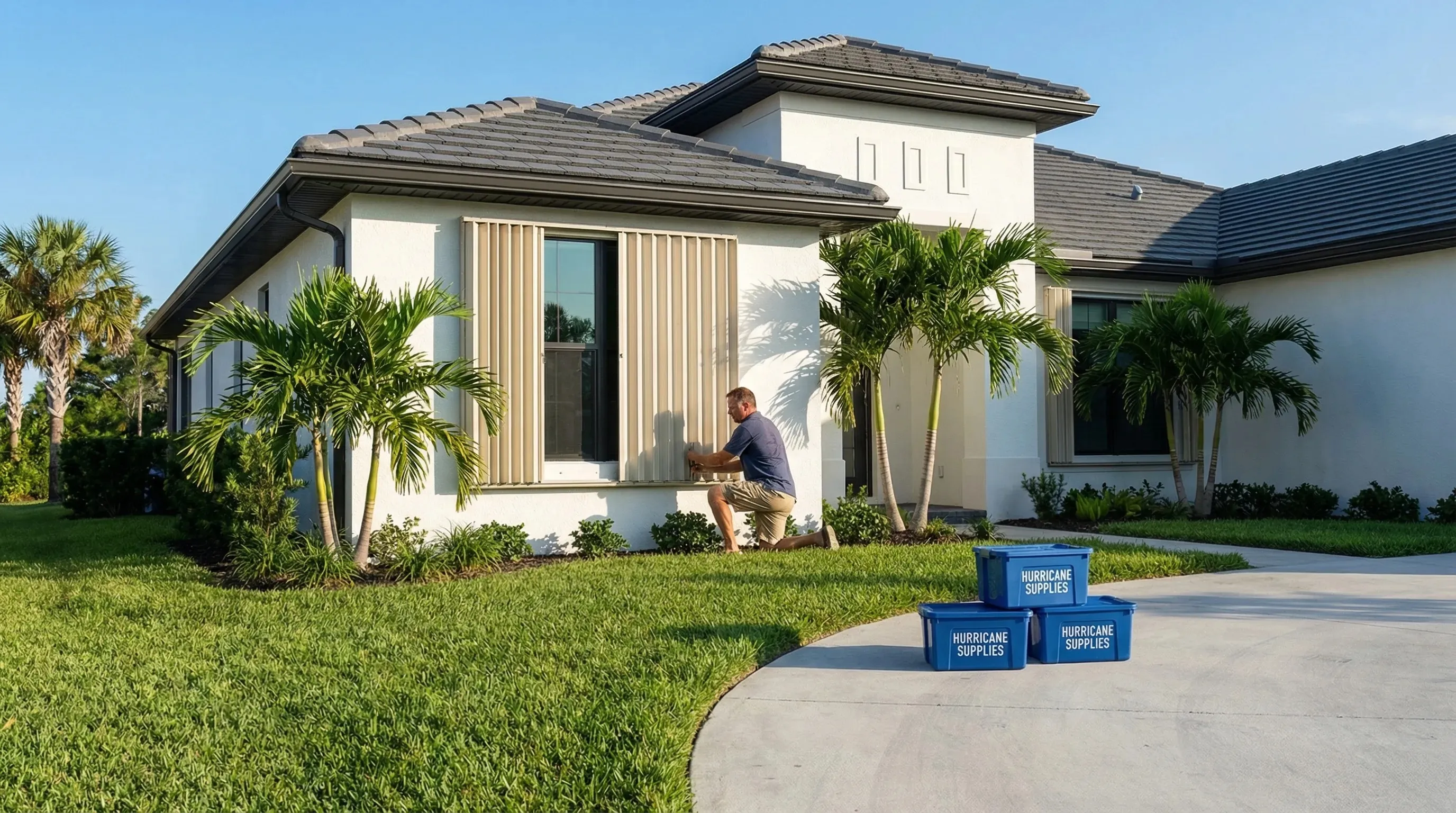
Charlotte County Florida home with hurricane shutters and palm trees under dramatic sky
All GuidesHomeownership

Hurricane Preparedness for Charlotte County Homeowners

Leo Albanes, BrokerApril 2, 2026 11 min read

Key Takeaways

  • 1Hurricane season runs June 1 through November 30, with peak activity in August-October.
  • 2Post-Hurricane Ian building codes require 150+ mph wind resistance, impact windows, and reinforced connections.
  • 3Wind mitigation features (impact windows, hip roof, hurricane straps) can reduce insurance by 30-50%.
  • 4Flood insurance is separate from homeowner's insurance β€” required in FEMA flood zones, recommended everywhere.
  • 5Create an evacuation plan: know your zone (A, B, or C), shelter locations, and evacuation routes.
  • 6Newer homes built to current Florida codes are significantly more resilient and insurable than pre-2004 construction.

Hurricane Charley's Legacy: How Charlotte County Rebuilt Stronger

On August 13, 2004, Hurricane Charley made landfall at Cayo Costa and tore through Charlotte County as a Category 4 storm with 150 mph winds. Punta Gorda and Port Charlotte suffered catastrophic damage β€” thousands of homes were destroyed or severely damaged, and the community faced years of rebuilding.

But from that devastation emerged one of the most remarkable rebuilding stories in American history. Charlotte County didn't just rebuild β€” it rebuilt better. The post-Charley construction boom produced thousands of homes built to Florida's updated Building Code (FBC 2004 and later), which is among the strictest in the nation for wind resistance.

What This Means for Today's Homebuyers:

  • Homes built 2005 or later meet the enhanced Florida Building Code, designed to withstand 140+ mph winds

  • Hip roofs (which shed wind efficiently) became standard instead of gable roofs

  • Impact-rated windows and doors became commonplace

  • Concrete block construction with reinforced tie-downs became the norm

  • These newer homes carry significantly lower insurance premiums β€” often 40–60% less than pre-2002 homes


The Bottom Line: If you're buying in Charlotte County, homes built after 2004 offer a genuine safety and financial advantage. They're engineered for hurricanes in ways that older Florida homes simply aren't. This is one reason I often steer buyers toward newer construction β€” the insurance savings alone can offset a higher purchase price.


Understanding Florida Homeowners Insurance

Insurance is the single most important financial consideration for Charlotte County homeowners, and navigating Florida's insurance landscape requires knowledge and strategy.

Current Insurance Climate (2026):
Florida's homeowners insurance market has stabilized somewhat after the turbulent 2022–2024 period, but rates remain among the highest in the nation. Charlotte County homeowners typically pay:

  • Post-2004 construction (no flood zone): $2,500–$4,500/year

  • Pre-2004 construction (no flood zone): $5,000–$8,000/year

  • Waterfront/flood zone properties: $6,000–$15,000+/year (including flood insurance)


Key Factors Affecting Your Premium:
1. Year Built β€” The single biggest factor. Post-FBC 2004 homes see dramatically lower rates.
2. Roof Age & Type β€” Hip roofs are cheaper to insure than gable. Roof age over 15 years triggers higher rates or non-renewal.
3. Opening Protection β€” Impact windows/doors or approved shutters earn significant discounts.
4. Distance from Coast β€” Properties within 1 mile of the Gulf pay higher wind premiums.
5. Flood Zone β€” FEMA Zone AE properties require separate flood insurance ($1,500–$5,000+/year).
6. Construction Type β€” Concrete block is preferred over frame construction.

Money-Saving Strategies:

  • Wind mitigation inspection: A $150 inspection can document features that earn 20–40% discounts (roof shape, opening protection, roof-to-wall connections, etc.)

  • Citizens Insurance: Florida's insurer of last resort offers competitive rates for some properties. Not always cheapest, but worth quoting.

  • Bundle policies: Many insurers discount when you combine home + auto

  • Raise your hurricane deductible: Moving from 2% to 5% hurricane deductible can save $500–$1,000/year

  • My Heritage program: Insures older homes that private carriers won't touch at reasonable rates


Home Hardening: Protecting Your Property

"Home hardening" means upgrading your property's ability to withstand hurricane-force winds and rain. These improvements protect your family, your investment, and often pay for themselves through insurance savings.

Priority 1: Roof (Most Critical)
Your roof is your home's first line of defense. In Charlotte County:

  • Replace aging roofs proactively β€” Don't wait for a claim. A new roof (metal or concrete tile) costs $15,000–$30,000 but can save $2,000–$4,000/year in insurance.

  • Metal roofing is increasingly popular β€” standing seam metal roofs rated for 160+ mph winds last 40–50 years and earn maximum insurance discounts.

  • Roof-to-wall connections (hurricane straps/clips) should be verified and upgraded if inadequate.


Priority 2: Opening Protection
Windows, doors, and garage doors are the most common failure points during hurricanes:
  • Impact-rated windows: $15,000–$25,000 for a typical home. Provide 24/7 protection without action needed before a storm. Best long-term investment.

  • Accordion shutters: $5,000–$10,000. Popular, easy to deploy, and earn full insurance discounts.

  • Roll-down shutters: $8,000–$15,000. Premium option β€” push-button deployment.

  • Hurricane-rated garage door: $1,500–$3,000. Garage doors are the #1 failure point. A reinforced door is essential.


Priority 3: Secondary Water Barrier
A sealed roof deck (SWR β€” Secondary Water Resistance) prevents water intrusion even if shingles are blown off. This is applied under the roof covering and earns insurance discounts.

Priority 4: Yard Preparation

  • Trim trees away from the house (especially dead branches and anything touching the roof)

  • Remove or secure anything that becomes a projectile in high winds

  • Ensure drainage paths are clear to prevent flooding


Insurance Credit Checklist:
After making improvements, always get an updated wind mitigation inspection. Each upgrade checked off translates directly to premium reductions. I've seen homeowners cut their insurance by 30–50% after a comprehensive home hardening project.


Evacuation Zones & Emergency Planning

Charlotte County uses a zone-based evacuation system tied to storm surge risk, not wind damage. Understanding your zone is critical for making safe decisions during hurricane season (June 1 – November 30).

Charlotte County Evacuation Zones:

  • Zone A (Highest Risk): Barrier islands (Boca Grande, Gasparilla), coastal areas, and low-lying waterfront. Evacuate for Category 1+.

  • Zone B: Areas near the harbor, rivers, and tidal waterways. Evacuate for Category 2+.

  • Zone C: Inland areas with moderate surge risk. Evacuate for Category 3+.

  • Zone D: Most inland locations. Typically shelter-in-place for all but the strongest storms.

  • Zone E: Highest ground, minimal surge risk. Shelter-in-place is usually safe.


Find your zone: Visit charlottecountyfl.gov and search "Know Your Zone" β€” enter your address for your specific designation.

Emergency Supply Kit (72-Hour Minimum):

  • Water: 1 gallon per person per day (minimum 3 days, recommend 7)

  • Non-perishable food and manual can opener

  • Medications (14-day supply minimum)

  • Flashlights, batteries, battery-powered radio

  • Important documents in waterproof container (insurance policies, deeds, IDs)

  • Cash (ATMs and card readers may be offline for days)

  • Full tank of gas in each vehicle

  • Portable phone chargers

  • Pet supplies if applicable


After the Storm:
  • Do not return until authorities give the all-clear

  • Photograph all damage before cleanup for insurance claims

  • Contact your insurance company immediately β€” early claims are processed faster

  • Beware of unlicensed contractors (Charlotte County requires contractor licensing)

  • Document everything β€” keep receipts for all emergency repairs


Local Resources:
  • Charlotte County Emergency Management: (941) 833-4000

  • Florida Division of Emergency Management: floridadisaster.org

  • NOAA Hurricane Center: nhc.noaa.gov


Buying a Hurricane-Resilient Home in Charlotte County

As your local real estate expert, here are the specific features I recommend prioritizing when buying in Charlotte County to minimize hurricane risk and insurance costs:

Must-Haves:
1. Built 2005 or later β€” Meets enhanced Florida Building Code
2. Concrete block construction β€” Standard in Charlotte County new construction
3. Hip roof β€” Aerodynamic shape sheds wind better than gable roofs
4. Impact windows and doors β€” Or at minimum, approved shutter systems already installed
5. FEMA Zone X β€” Minimal flood risk, no mandatory flood insurance

Strong Preferences:

  • Metal roof (longest life, best wind rating, lowest insurance)

  • Whole-home generator hookup or installed generator

  • Hurricane-rated garage door

  • Elevated living area (if near waterways)

  • Newer electrical panel (200-amp)


Red Flags:
  • Roof over 15 years old (expect replacement within 1–3 years)

  • Gable roof with no reinforcement

  • Frame construction (wood frame is more vulnerable than concrete block)

  • Flood zone AE or VE (high flood insurance costs)

  • No opening protection (windows, doors, garage)

  • Older mobile/manufactured homes (extremely vulnerable)


My Role in Your Purchase:
I evaluate every property I show through the lens of hurricane resilience and insurance costs. Before you make an offer, I'll help you understand the likely insurance costs, identify needed improvements, and negotiate accordingly. Many buyers from out of state don't consider these factors until after closing β€” by then it's too late to negotiate. Call (941) 626-9000 to start your search with hurricane resilience built into the strategy from day one.


Hurricane Season Timeline & Preparation Calendar

Hurricane season runs June 1 through November 30, with peak activity in August and September. Smart homeowners follow a preparation calendar:

April–May (Pre-Season):

  • Review and renew homeowners and flood insurance policies

  • Schedule wind mitigation inspection if improvements were made

  • Test generator and stock fuel

  • Trim trees and remove dead vegetation

  • Inventory home contents (video walkthrough stored in cloud)

  • Verify evacuation route and destination

  • Stock initial emergency supplies


June–August (Early/Mid Season):
  • Monitor National Hurricane Center forecasts weekly

  • Keep gas tanks at least half full

  • Ensure prescription medications are current and stocked

  • Pre-stage shutter hardware or verify impact window integrity

  • Establish communication plan with family members


September–October (Peak Season):
  • Highest vigilance period β€” check forecasts daily during active weather

  • Be prepared to execute hurricane plan with 48–72 hours notice

  • Keep important documents accessible

  • Maintain charged devices and backup power sources


November (Late Season):
  • Season officially ends November 30

  • Post-season home inspection β€” check roof, gutters, and drainage

  • Evaluate any needed improvements for next season

  • Many contractors offer off-season discounts for hurricane hardening projects


The Charlotte County Advantage:
Having lived through Hurricane Charley and its aftermath, our community is exceptionally well-prepared. Charlotte County's emergency management system is one of the best in Florida, with well-practiced evacuation routes, designated shelters, and rapid post-storm response. Neighbors help neighbors here β€” that community spirit is one of the best things about living in Charlotte County.

Frequently Asked Questions

How often do hurricanes hit Charlotte County?

Direct hits are relatively rare β€” Hurricane Charley in 2004 was the last major hurricane to directly impact Charlotte County. However, the area experiences tropical storm conditions (high winds, heavy rain, storm surge) more frequently, perhaps every 3–5 years on average. The entire Gulf Coast of Florida carries hurricane risk, but Charlotte County's post-Charley rebuilt infrastructure means it's better prepared than most areas.


How much does hurricane insurance cost in Charlotte County?

Homeowners insurance (which covers wind/hurricane damage) typically costs $2,500–$4,500/year for homes built after 2004 outside flood zones, and $5,000–$8,000+/year for older homes. Flood insurance is separate and costs $1,500–$5,000+/year for properties in FEMA flood zones. A wind mitigation inspection ($150) can document features that reduce premiums by 20–40%. The year your home was built is the single biggest factor in your rate.


Are newer homes in Charlotte County really hurricane-proof?

No home is truly "hurricane-proof," but homes built to the Florida Building Code 2004 and later are remarkably resilient. They're engineered to withstand 140+ mph sustained winds with features like reinforced concrete block walls, hurricane straps connecting roof to walls, impact-rated glazing, and hip roof designs. During subsequent storms, these newer homes have performed dramatically better than older construction, with minimal structural damage in most cases.


Should I buy a home in a flood zone in Charlotte County?

It depends on your tolerance for risk and additional costs. Flood zone properties (AE, VE) require flood insurance, which adds $1,500–$5,000+/year to your costs. The properties are also harder to sell. That said, some of Charlotte County's most desirable waterfront properties are in flood zones, and the views and lifestyle can be worth it for the right buyer. I always ensure clients understand the full cost picture before purchasing in a flood zone.


What should I do first to reduce my hurricane risk as a new homeowner?

Get a wind mitigation inspection ($150) immediately β€” this documents what protections your home already has and identifies the highest-impact improvements. Then prioritize: 1) Roof condition and age, 2) Opening protection (impact windows/shutters, especially garage door), 3) Yard tree trimming. Each improvement not only protects your home but also reduces insurance premiums. I can recommend trusted local contractors for all of these services.

Have Questions About Charlotte County?

I've helped hundreds of families find their perfect home here. Let's talk about what you're looking for.
Continue Reading